
The installation of warm water underfloor heating
Warm water underfloor heating offers an efficient and comfortable way to heat a space. This method uses warm water as the heat source and comes with four different installation techniques. Each technique has its own specific advantages and applications, which gives you the freedom to make the choice that fits your needs and situation.
Mounting mats
Installation of warm water underfloor heating by means of mounting mats is a method whereby the heating pipes are attached to galvanised mounting mats. After these mats are laid, a layer of concrete or anhydrite is poured and the floor finish can be applied.
Tacker board
With this method the heating pipes are mounted on a tacker board, which is a kind of insulation board with anchor points, by means of U-clips. Afterwards, a layer of cement or anhydrite is poured and the floor finish can be applied. The board ensures that the pipes will remain in place, while the insulation helps distribute heat efficiently.
Pre-milled overlay panels
This installation method uses pre-milled underfloor heating panels. These panels, which are usually made from a plaster-bound material and vary in thickness from 15 to 25 mm, are specifically designed to house the heating pipes. The procedure starts by placing these panels on top of the screed in a pre-determined pattern. Then the heating pipes are placed into the panels’ pre-milled channels.
In-ground underfloor heating
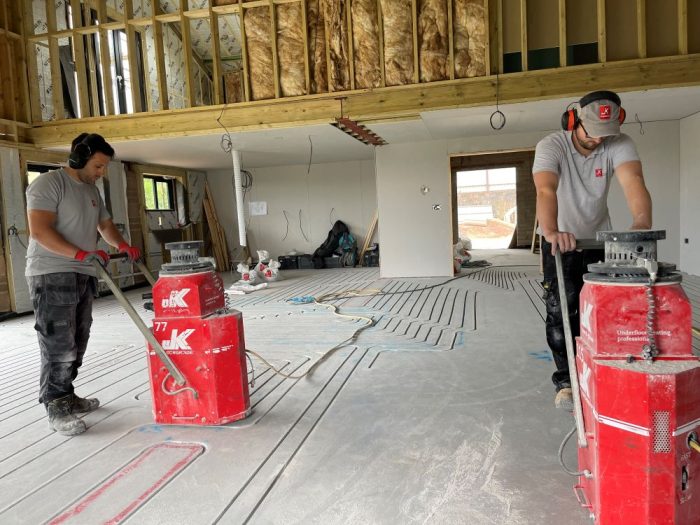
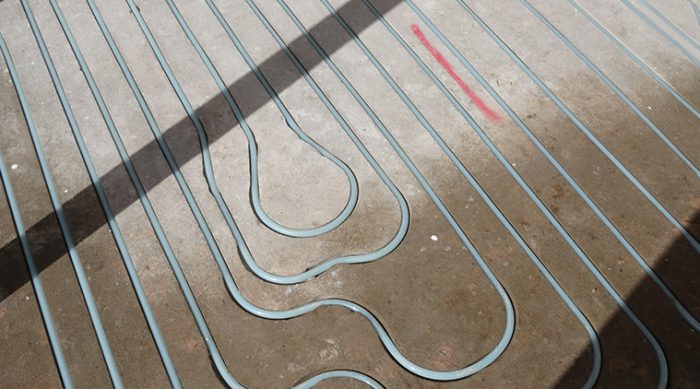
The JK® system, invented by Janssen & Krop in 1994, places the heating pipes into grooves that are cut into the screed. This method is suitable for both new and existing screeds. After the pipes are placed, underfloor heating can be installed directly with no requirement of an additional layer of concrete or anhydrite. This sets the JK® system apart from other underfloor heating methods.
The variety of installation methods lends installing underfloor heating plenty of flexibility, depending on the specific nature of the construction project and the type of screed. The kind of floor finish that is chosen also plays a part. This diversity allows builders and home owners to chose the most suitable approach to their unique situation.
Electric underfloor heating
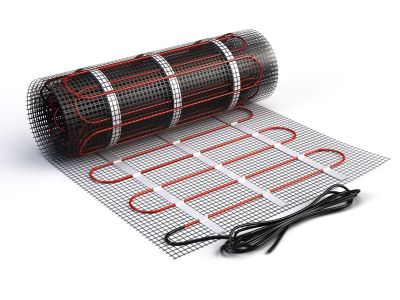
Electric underfloor heating is a system whereby heating cables or mats are installed under the surface of the floor to generate heat. These cables or mats are heated by means of electricity and distribute heat evenly across the entire floor.
Installing electric underfloor heating
The installation of electric underfloor heating starts with the preparation of the screed. Here, heating cables and mats are carefully placed the right distance from each other and connected. Then a choice of floor finish is placed on top of the mats, e.g. tiles or laminate.
Advantages and disadvantages of electric underfloor heating
Just like with any other system there are up- and downsides. When choosing a kind of underfloor heating, carefully consider what fits you and your situation best so you can make an informed choice.
One of the benefits of electric underfloor heating is its easy installation. Generally speaking, there is no need for a plumber during the installation process because pipes and connections are not involved. Another advantage is the precision with which the temperature can be regulated: rooms can be set individually.
The biggest drawback to electric underfloor heating is its energy consumption. Electric underfloor heating systems can mean high energy costs compared to other heating methods. Especially in larger spaces, energy usage can mount considerably. Moreover, despite the fact that the installation seems more straightforward, there are more costs involved. Purchasing the heating cables and insulation mats, and the installation itself have a higher initial cost than , for example , the installation of warm water underfloor heating. Therefore, it is important to offset the initial costs with long term benefits to make a well-informed choice.