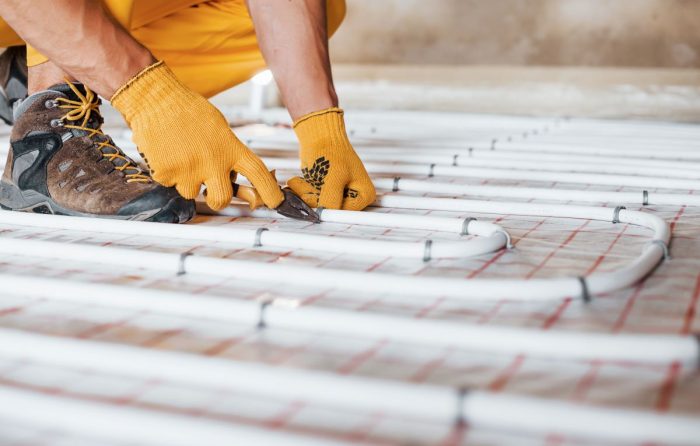
Tacking refers to the process of securing underfloor heating pipes to insulation boards or the subfloor using pipe staples or clips. These are applied at regular intervals—usually with a tacker gun—to keep the pipes firmly in place before the screed is poured. Tacking ensures that the pipe layout remains stable, evenly spaced, and fixed during installation, helping to deliver consistent heat distribution across the floor.
Advantages of In-Ground UFH over Tacking Systems
In-ground underfloor heating systems like the JK System – where pipes are laid into grooves milled directly into the existing floor – offers a number of practical and performance advantages over traditional tacked systems, where pipes are stapled onto insulation boards.
1. No Floor Build-Up
- In-Ground: Pipes are embedded into the existing floor surface, requiring no added height.
- Tacked: Pipes sit above insulation and need a full layer of screed, increasing floor height by 50–75mm or more.
- ? Ideal for renovations where ceiling height or existing floor levels need to be preserved.
2. No Screed Drying Time
- In-Ground: No wet trades—flooring can be installed almost immediately after pipework is complete.
- Tacked: Wet screed needs up to 28 days to dry before finishing floors can be laid.
- ? Speeds up project timelines significantly.
3. Faster Heat-Up Times
- In-Ground: Pipes sit closer to the floor surface, delivering heat more quickly.
- Tacked: Screed must warm before the heat reaches the floor finish, which slows response times.
- ? More responsive and energy-efficient heating performance.
4. Cleaner, More Precise Installation
- In-Ground: Milling machines create accurate pipe grooves, reducing installation errors and mess.
- Tacked: Manual pipe fixing can lead to inconsistent spacing and uneven heat distribution.
- ? Provides a neater, professional finish with optimal pipe layout.
5. No Insulation or Fixing Hardware Needed
- In-Ground: No need for pipe staples, clips, or insulation boards on top of the slab.
- Tacked: Requires extensive hardware and preparation, increasing complexity and cost.
- ? Reduces material use and simplifies logistics.
6. Lower Risk of Pipe Movement
- In-Ground: Pipes are locked into solid grooves—no chance of floating or shifting during installation.
- Tacked: Pipes can shift if staples aren’t secure, especially when screed is poured.
- ? Improves long-term reliability of the system.