
Screeds
Screeds form an integral part of building and renovation projects. These floor layers are placed on top of the construction floor and play a crucial role in the creation of a flat and durable surface for the eventual floor finish. Screeds may contain different materials and employ different techniques, depending on the specific needs and requirements of the project. Common types are sand cement, concrete screeds and the anhydrite floor. This type of screed offers a sturdy and stable surface and can compensate for irregularities in the floor plate.
Sand cement screed
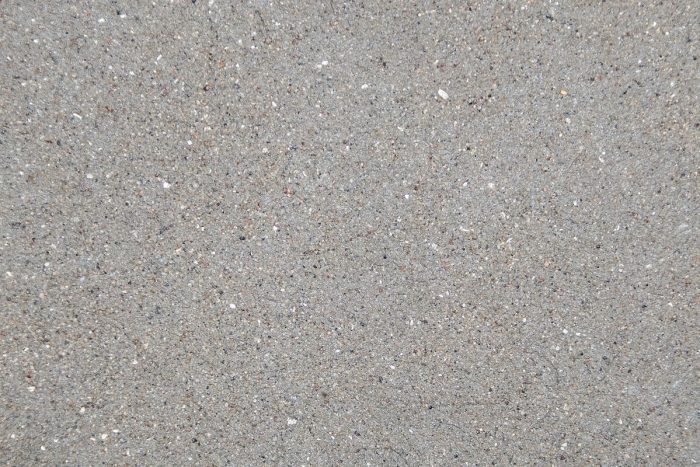
Sand cement screeds are a popular choice as finishing layer in buildings. These screeds are composed of a mixture of sand, cement and water that is applied to the screed, usually with a thickness of five to six centimetres. They form a sturdy basis for various kinds of floor coverings and are generally quite compatible with different underfloor heating systems, including the in-ground JK® system.
Anhydrite floor
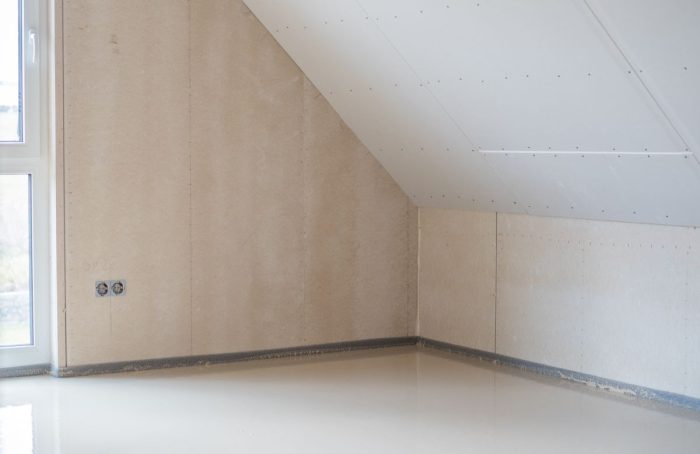
The anhydrite floor is a type of screed that is increasingly used in modern construction projects. These gypsum-bound floors consist of a mixture of anhydrite (calcium sulphate), sand and water, and are poured onto the floor in a liquid form so that they form an even and tight floor after curing. Due to the fast drying time and good heat conductivity, anhydrite floors are very suitable for underfloor heating. However, it is important that the anhydrite floor is fully cured before the underfloor heating is installed to prevent possible damage.
Concrete floor
A concrete floor consists of a mixture of cement, sand, gravel, and water. Depending on the mix proportions and for instance the addition of pebbles and rocks the concrete floor may sometimes be too hard to be ground into. To test whether the screed is suitable for in-ground underfloor heating, JK first performs a trial milling. In most cases concrete floors can be ground into well, but in a few cases it may turn out the floor is too hard. This can happen for instance when there is steel reinforcement present in the floor.
Luckily, a concrete floor is not often used as a screed, because by their very nature they are not very smooth due to the presence of pebbles and rocks. To make the floor smooth, a costly technique called ‘power trowelling’ would have to be applied, which is not common.
In the Netherlands, Belgium and Germany sand cement, concrete and anhydrite floors are the most common. In England, Scotland and Ireland concrete floors are more common. These concrete floors often contain a lot of pebbles and require special cooling techniques for the JK® Floorgrinder to be able to work with them. All floor types are tested, approved and can be provided with the JK® system.
Tile floor
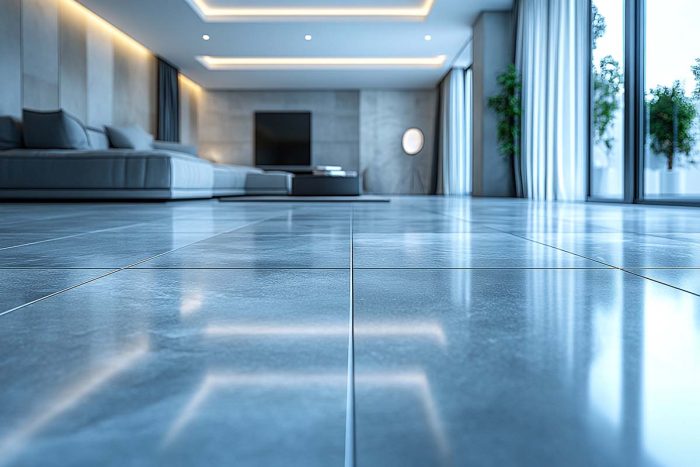
During renovation situations may arise where it is not feasible to remove the existing tiles, e.g. because they are bonded to the screed. In these cases, removing the tiles may be risky. If the tiles are bonded firmly to the screed, removing them can damage the screed, necessitating repair, levelling or even replacement. Moreover, there are often utility lines in the screed that could also incur damage when the tiles are removed, which would subsequently also require repairing or replacing.
In such cases, grinding into ceramic tile, flagstone, terrazzo or terracotta tiles offer a practical and effective solution. The JK® method makes it possible to integrate underfloor heating into the tiles.
In addition, not only is grinding into existing tiles time and cost saving, it also minimalises inconvenience, as the existing tiles are kept rather than removed. Moreover, there will also be less construction waste, which makes it an environmentally friendly choice. The only downside is that keeping the old tiles will lead to a slight increase in floor build up.
Trial milling
When grinding the JK® system into an existing tile floor we run through a meticulous process to make sure that your floor is fit for this method. Our first step is a thorough inspection whereby we judge the state of the tile floor. During this process we mill a trial cut, grinding into a portion of the floor to see how the tiles react to the grinding process.
One of the unique aspects of the JK® system is the use of the JK Floorgrinder. This bespoke milling machine was exclusively designed for the JK® system and is particularly suitable for tile floors. Thanks to advanced functions such as water cooling, vibration control and automatic drive we can work efficiently, even on very hard surfaces. This means that we can grind in the underfloor heating with precision, without unnecessarily damaging the existing tile floor.
If it appears that during the trial milling the tiles are coming undone and are not as bonded to the screed as expected, there is still the option of removing the entire tile floor. In other cases where the tiles are properly bonded, we can proceed to grinding in the underfloor heating.
Existing screed
The JK® system can be integrated simply in existing floor constructions, especially in older buildings. This means you do not have to worry about a specific type of screed, because the JK® system is compatible with almost all kinds of them. Thereby you can rely on thorough testing and supporting documentation, which is available to you.
Do bear in mind that the JK® system is specifically designed to grind our underfloor heating system into an existing screed. It is not at all obvious that other systems would also be suitable for the floor construction without prior verification. Factors such as the grinding method, vibrations and laying distance play a crucial role in the successful implementation of this solution.
It is important to take a number of things into account with existing screeds as well, because they may influence the eventual finish of the floor. In the construction industry a distinction is made between three types of screeds: adhesive, non-adhesive and floating screeds. It is important here as well to take into account the different layers of the floor construction: some screeds are placed directly on top of the insulation layer, whereas others are on the floor plate. The JK® system is suited to both adhesive and non-adhesive screeds without endangering their adhesion or stability.
Adhesive screeds
An adhesive screed is a type of floor covering that is applied directly to the floor plate and that adheres firmly to it. This type of screed is primarily used in situations where stability and adhesion are essential. An example of an adhesive screed is poured concrete with reinforcement meshes.
An adhesive screed can only be applied on stable, cohesive floor plates with no active cracks. Before the screed is placed, it is therefore important that the surface is completely dust free and any remaining cement film has been removed.
Non-adhesive screeds
With non-adhesive screeds a partition is inserted between the screed and the floor plate, e.g. a damp proof membrane. This way the screed does not adhere anywhere to the surface. It is advisable to place perimeter joints and possibly expansion joints, because the screed can move under the influence of moisture and heat. Especially with large heated surfaces (> 40m²) and lengths of over 8 meters these joints are important to offer the required flexibility and to prevent damage to surrounding structures.
Floating screeds
Floating screeds are often applied to improve on sound and heat insulation, especially in situations in which thermal comfort and acoustic dampening are of the utmost importance. Because the screed is not attached directly to the floor plate, but instead rests on a compactable insulation layer, the screed may show some movement.
To absorb and distribute any movement of the screed, distribution joints are necessary. These joints prevent tensions from building up and cracks forming in the screed. It is extremely important that the distribution joints are placed at the correct distances, according to the guidelines and specifications of the project.
Insulation foil
When you are expanding or installing a new screed, insulation foil may be a consideration. This foil consists of a 3 mm thick polyethylene foam with a metallised aluminium foil and a reflecting layer on top. The goal of the insulation foil is to create a “floating” screed, especially with traditional underfloor heating systems. The benefit of this partition between the floor plate and the screed is that any cracks in the floor plate will not impact the screed.
The polyethylene foam functions as an insulation layer that reduces the heating of the floor plate. In addition, the reflective properties of the aluminium foil heat the screed substantially faster, up to 25% according to data provided by the supplier. Another positive aspect of the insulation foil is the water- and damp-proof properties of the aluminium reflective layer, which allow this foil to function as a hydrophobic layer in anhydrite screeds as well.